

Why Women Lead the Biodynamic Wine Movement
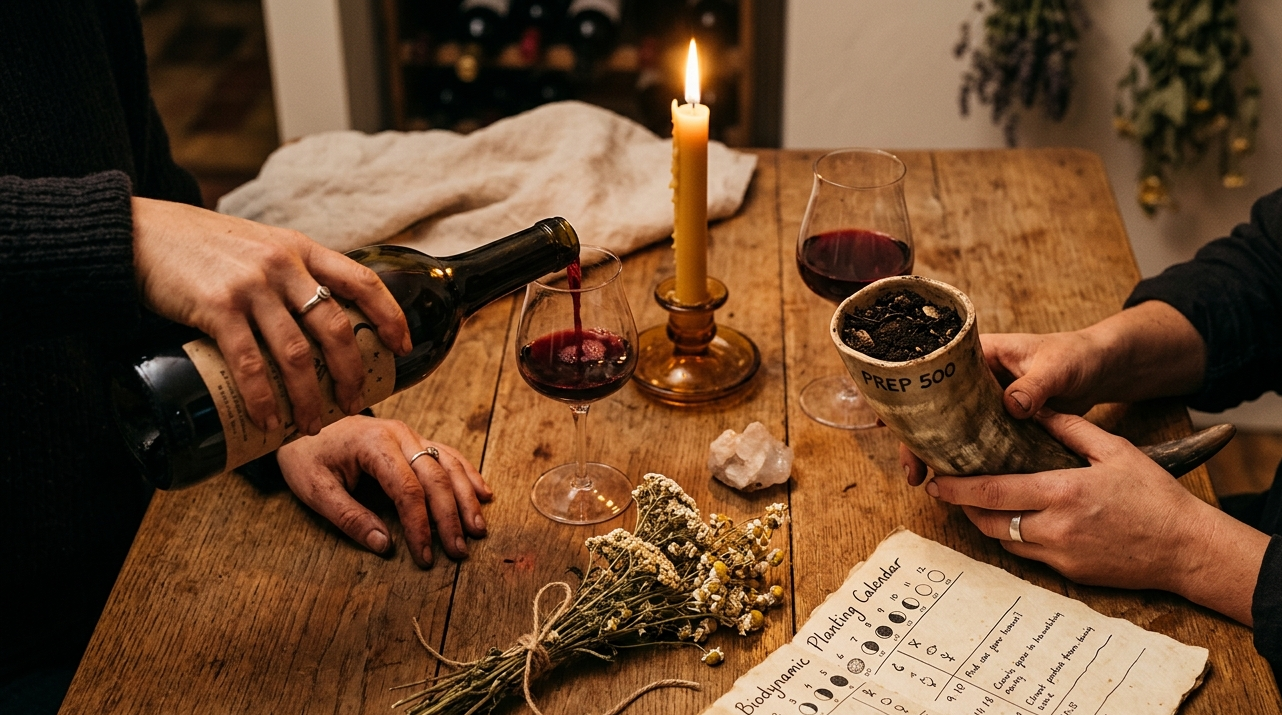
The wine industry has been male-dominated for centuries. The cellar, the vineyard, the tasting room, the auction house — these have traditionally been spaces where men set the terms. But there is one corner of the wine world where the story is different. Where the most important figures, the pioneers, the risk-takers, the ones who changed everything, are overwhelmingly women.
That corner is biodynamic wine.
The most expensive wine in the world? Made by a woman who has been farming biodynamically since 1988. The person who saved one of Burgundy’s greatest white wine estates through biodynamic conversion? A woman. The founder of the world’s largest natural and biodynamic wine community? A woman. The person who created the biodynamic calendar that every biodynamic farmer on the planet still uses? A woman. The Sicilian winemaker who proved that biodynamic wine could be made on a massive scale without compromising a single principle? A woman.
This is not a coincidence. There is something about biodynamic farming — its attentiveness, its patience, its insistence on listening rather than controlling — that has attracted women who refuse to do things the conventional way. They were called eccentric, impractical, even mad. They were right.
Lalou Bize-Leroy: The Queen of Burgundy
Any story about women in biodynamic wine begins with Lalou Bize-Leroy. Born in 1932 into one of Burgundy’s great wine families, she joined the family négociant business, Maison Leroy, in 1955 and became co-manager of Domaine de la Romanée-Conti in 1974 — the most famous wine estate in the world.
But it was what she did next that changed everything. In 1988, she founded Domaine Leroy, acquired some of the finest vineyard parcels in Burgundy, and made a decision that stunned the wine world: she converted the entire estate to biodynamic farming. At the time, biodynamic was considered fringe, even absurd. In conservative Burgundy, where tradition is gospel, people thought she had lost her mind.
Then came 1993. Humidity swept the Côte d’Or, mildew devastated vineyards across the region, and conventional growers reached for their chemical sprays. Lalou’s biodynamic principles forbade it. She lost a huge portion of her harvest. Journalists arrived at her vineyards to survey the damage. Her neighbours called her a madwoman whose vines were dying.
She did not flinch. She did not spray. And when her tiny 1993 vintage was finally released, the quality was exactly the extraordinary level she demanded. The doubters went quiet.
Today, Domaine Leroy’s Musigny Grand Cru is the most expensive wine on the planet at $48,715 per bottle. Six of the ten most expensive wines in the world are hers. She produces just 600 cases a year. Every vineyard is ploughed by horse. Every decision follows the lunar calendar. At 93, she is still hands-on at every harvest, still inspecting every vine.
“Biodynamics is a meaningless term,” she has said. “What people used to do was biodynamic, it just wasn’t called that. Biodynamics involves taking the view that everything is alive and then respecting that life.”
Anne-Claude Leflaive: The Woman Who Saved White Burgundy
If Lalou Bize-Leroy is the queen of red Burgundy, Anne-Claude Leflaive is her counterpart in white. She took charge of Domaine Leflaive, one of the most prestigious white wine estates in the world, and in the 1990s made the radical decision to convert to biodynamic farming.
The story of how she got there is wonderfully improbable. Her first encounter with biodynamics came from a flyer she spotted in a Dijon grocery store. It led her to investigate, then to experiment, and finally to commit entirely.
What convinced her was a blind tasting. She showed two wines from the same vineyard, the 1996 Puligny-Montrachet Premier Cru Clavoillon — one made from organically farmed grapes, the other from biodynamically farmed grapes. Every journalist and importer in the room preferred the biodynamic wine, describing it as fresher and more alive. From that moment, there was no going back.
Anne-Claude claimed that biodynamic methods saved a badly diseased vineyard, restoring it to the point where it produced some of the domaine’s most highly prized wines. Under her leadership, Domaine Leflaive was re-established at the summit of white Burgundy.
“If you smell the soil in a biodynamic vineyard, it’s rich, it’s wonderful, it’s full of life,” she said. “When people call me a madwoman for believing in biodynamics, it’s because they haven’t experienced this.”
She died in 2015 at just 59. Her legacy is immense. Not only in the wines she made, but in proving to the sceptics that biodynamic farming was not a retreat from excellence — it was a path toward it.
Maria Thun: The High Priestess
Every biodynamic winemaker in the world follows a calendar. That calendar was created by Maria Thun.
Thun was a German researcher who spent decades studying the relationship between cosmic rhythms and plant growth. She divided the days of the year into four categories — Root Days, Fruit Days, Flower Days, and Leaf Days — each corresponding to one of the classical elements: earth, fire, air, and water. These categories determine when biodynamic farmers plant, prune, harvest, and bottle.
Without Maria Thun’s work, the practical framework of biodynamic farming would not exist. She translated Rudolf Steiner’s philosophical lectures from 1924 into a usable system that farmers could follow season by season. Her biodynamic sowing and planting calendar, published annually from 1963 until her death in 2012, remains the standard reference for biodynamic practitioners worldwide.
She is not a household name. She should be. Every biodynamic bottle you drink was shaped, in part, by her work.
Isabelle Legeron: The Evangelist
If the women above built biodynamic wine from the vineyard up, Isabelle Legeron built the community around it.
Legeron is the first French woman to become a Master of Wine and was named Wine Woman of the Year in Paris in 2009. In 2012, she founded RAW WINE, which has grown into the world’s largest community of natural, organic, and biodynamic wine producers. RAW WINE now hosts annual fairs in London, Berlin, New York, Los Angeles, Montréal, Toronto, Paris, Copenhagen, and Tokyo, connecting growers directly with the people who drink their wine.
Legeron grew up on a farm in Cognac and initially pursued a conventional career in wine. But she became disillusioned with the corporate side of the industry. She found that the wines at the top of the scoring systems were starting to taste the same — polished, processed, disconnected from the land. She turned to natural and biodynamic wine because it was the opposite: alive, unpredictable, honest.
Her book, Natural Wine, became the definitive guide for consumers wanting to understand what biodynamic and natural wine actually means. Her work has done more to bring biodynamic wine to a mainstream audience than perhaps anyone else alive.
Elisabetta Foradori: The Philosopher
Elisabetta Foradori did not choose winemaking. It chose her. When her father died prematurely, she was thrust into managing the family estate in Trentino, northern Italy. She was young, untrained, and operating more from duty than passion.
But the passion came. Through the work itself — through the vines, the soil, the slow process of learning to listen rather than impose. Inspired by a friend in Alsace who farmed biodynamically, Foradori turned to Rudolf Steiner’s philosophies and transformed not only her estate but her entire approach to winemaking.
“I am an advocate of science,” she has said, “but science without a philosophy is all technique, and technique has no soul.”
Her wines — made from the indigenous Teroldego grape, fermented in terracotta amphorae, farmed biodynamically — are now considered among the finest in Italy. She moved away from new oak and extractive winemaking toward something more sensitive, more connected to the land. The wines became liberated, more balanced, more expressive of their place.
Foradori is the winemaker-as-philosopher: someone for whom biodynamics is not just a farming method but a way of understanding the relationship between the human and the natural world.
Arianna Occhipinti: The Rebel
Arianna Occhipinti fell in love with wine at 16, when her uncle, Giusto Occhipinti of the celebrated COS winery, took her to Vinitaly, Italy’s annual wine fair. She was captivated by the energy, the passion, the people. She enrolled in enology school in Milan immediately.
But university frustrated her. She clashed with teachers who wanted to teach industrial recipes for constructing wine in a laboratory. At 21, she wrote a letter to the legendary Italian wine philosopher Gino Veronelli that became famous in Italian wine circles: “Every day, I experience false oenology, weighed down by the pressure of industrial forces. Wine is not something to be constructed from a distance by hands that aren’t paying attention. Wine has to be accompanied.”
She did not wait for the debate to resolve itself. She went home to Sicily, planted one hectare of vines around her parents’ house in Vittoria, and at 22 released her first vintage under her own name.
Two decades later, Arianna Occhipinti is one of the most celebrated winemakers in Italy and one of the largest producers of biodynamic wine in the world, making over 120,000 bottles a year. Her SP68 Rosso — a blend of the indigenous Sicilian grapes Frappato and Nero d’Avola, named after the ancient road that passes her property — has become iconic. No added sulphur, no filtration, wild yeast fermentation, 30 days on skins, aged in cement.
She has also helped save Albanello, a nearly extinct Sicilian white grape variety, by planting entire vineyards of it. And she has restored a traditional palmento — the ancient Sicilian stone winemaking building — with plans to turn it into a school for young winemakers, where the most important teacher would be the land itself.
Occhipinti’s memoir is called Natural Woman. In it, she writes: “I became a woman while I was learning to make wine.”
She proves that biodynamic wine does not have to mean tiny production and astronomical prices. It can mean 120,000 bottles of honest, terroir-driven, deeply Sicilian wine that costs £15 and changes how you think about what wine can be.
Vanya Cullen: The Pioneer Down Under
On the other side of the world, Vanya Cullen brought biodynamic farming to Margaret River, one of Australia’s most prestigious wine regions. The youngest of six children, she grew up with pioneering parents whose Wilyabrup estate helped transform Margaret River into a world-renowned region.
Named chief winemaker at Cullen Wines in 1989, Vanya committed fully to biodynamic and organic practices. Her wines have won consistent international acclaim, and in 2020 she was awarded James Halliday’s Winemaker of the Year — one of Australia’s highest honours. She proved that biodynamics could thrive outside the European heartland, in a climate and terroir entirely different from Burgundy or Alsace.
The Women of Alsace
Alsace is home to some of the world’s greatest biodynamic producers, and many of them are led by women. Sophie Barmès of Domaine Barmès-Buecher, certified biodynamic since 2001, took over the estate after the tragic death of her father. Her philosophy is simple and radical: “We let nature decide. We let the wine decide.”
Véronique Muré, a 12th-generation winemaker, manages 70 acres of certified biodynamic vines including the Grand Cru Clos Saint Landelin. Caroline Frey implemented organic and biodynamic practices at the renowned Paul Jaboulet Aîné in the Northern Rhône. And in California, three generations of Frey women — Katrina, Molly, and Eliza — run Frey Vineyards, America’s first organic winery and the first in the US to achieve Demeter biodynamic certification, back in 1996.
The pattern repeats across every wine region in the world. Wherever biodynamic wine is being made with conviction and courage, there is very often a woman at the centre of it.
Why Women?
Why does biodynamic wine have so many women at its forefront? There is no single answer, but there are patterns.
Biodynamic farming is, at its core, about relationship. It asks the farmer to listen to the land rather than impose upon it. To observe cycles — lunar, seasonal, ecological — and respond to them rather than override them. To see the vineyard not as a production line but as a living organism that must be nurtured.
Many of the women who have led this movement describe their work in exactly these terms. Lalou Bize-Leroy talks about her vines as living individuals with their own personalities. Elisabetta Foradori speaks of listening rather than controlling. Arianna Occhipinti says wine must be accompanied, not constructed. Sophie Barmès says she lets nature decide.
There is also the fact that biodynamic farming was, for decades, considered eccentric. Mainstream wine culture dismissed it. This may have inadvertently created space for women who were already used to operating outside the male-dominated mainstream of the industry. If you were going to be dismissed anyway, you might as well be dismissed for something you believed in.
And then there is Maria Thun, whose contribution is foundational but often overlooked. She created the calendar. She translated philosophy into practice. She made biodynamic farming something you could actually do, season by season, day by day. Without her, none of the rest of this story happens.
What This Means for Vino Cosmo
At Vino Cosmo, every wine we pour is biodynamic. And now you know: behind almost every one of those bottles, there is a woman who chose the hardest path, who was told she was wrong, and who made wine that speaks for itself.
When we host a tasting under a full moon and talk about the connection between wine and the cosmos, we are continuing a tradition that Lalou Bize-Leroy, Anne-Claude Leflaive, Maria Thun, Elisabetta Foradori, Arianna Occhipinti, and Isabelle Legeron built. They did not just make biodynamic wine possible. They made it undeniable.
The next time someone questions whether biodynamic wine is serious, tell them about the madwoman in Burgundy who makes the most expensive wine on earth. Tell them about the Sicilian rebel who produces 120,000 bottles a year with no added sulphur. Tell them about the German researcher who created the calendar that every biodynamic farmer in the world still follows.