

What Is Biodynamic Wine? Everything You Need to Know
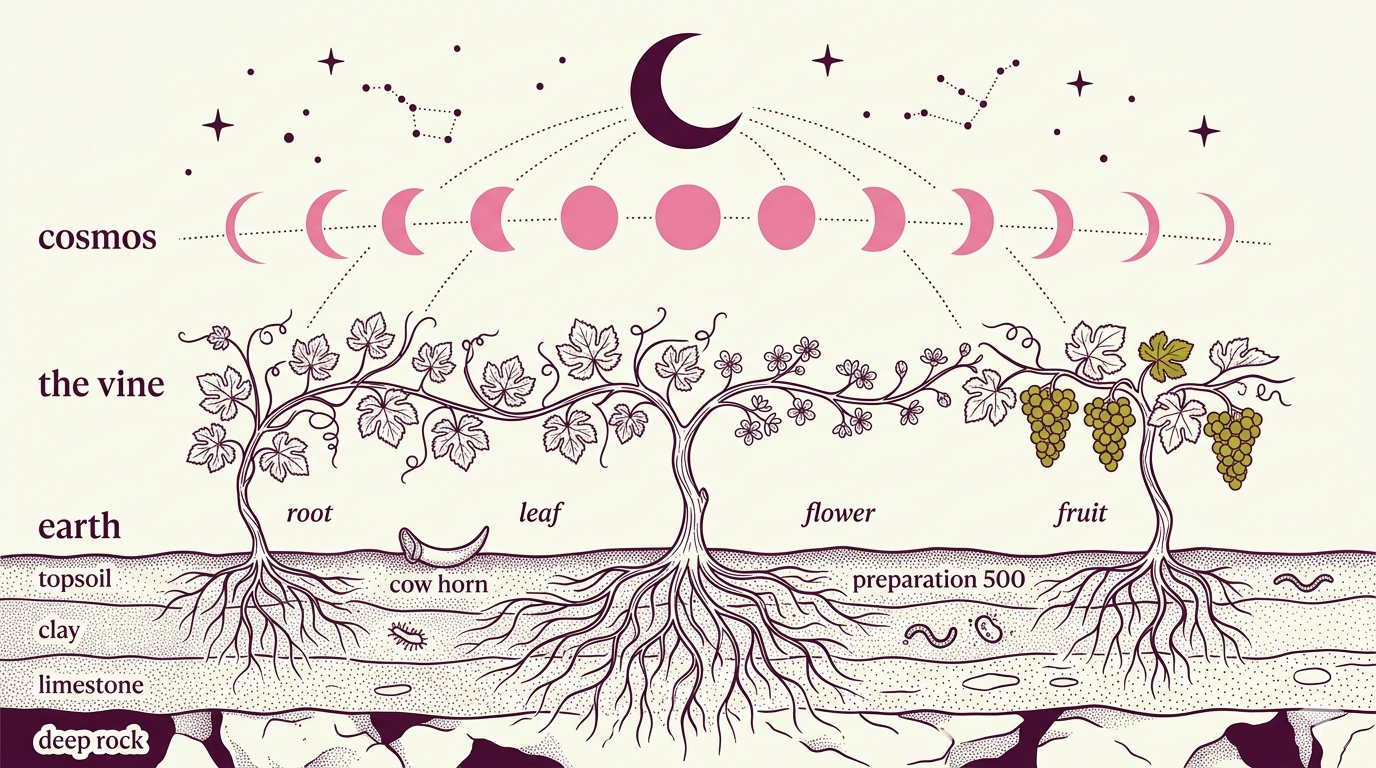
The complete guide to biodynamic farming, lunar rhythms, and why some of the world's most respected vineyards farm by the cosmos.
The Short Answer
Biodynamic wine is wine made from grapes grown using biodynamic agriculture: a holistic farming method that treats the vineyard as a living, self-sustaining ecosystem and follows the rhythms of the moon, the sun, and the stars to guide everything from planting to harvesting.
It goes beyond organic. Where organic farming focuses on what you leave out (no synthetic pesticides, no chemical fertilisers), biodynamic farming adds a whole layer of what you put in: natural preparations to build soil health, biodiversity to create balance, and a cosmic calendar that connects the work of the vineyard to the cycles of the natural world.
If that sounds a bit out there, stay with me. Some of the most acclaimed vineyards on the planet farm biodynamically, and the wines they produce are among the most expressive, terroir-driven bottles you will ever taste.
Where Did Biodynamics Come From?
Rudolf Steiner, Austrian philosopher
Biodynamic agriculture was developed by the Austrian philosopher Rudolf Steiner in 1924, making it one of the oldest sustainable farming movements in the world. It predates the modern organic movement by about two decades.
Steiner gave a series of lectures to farmers in what is now Poland, proposing a radical idea: that a farm should function as a complete, self-contained organism. Everything on the farm, the soil, the plants, the animals, the farmer, and even the position of the moon, was interconnected and interdependent.
At the time, European farmers were already noticing that newly introduced synthetic fertilisers were degrading their soil. Steiner's approach offered an alternative: work with nature's rhythms instead of against them. Nearly a century later, his principles are practised by vineyards in France, Italy, Germany, Spain, Austria, Australia, South Africa, Chile, Argentina, the United States, and beyond.
How Is Biodynamic Wine Different from Organic Wine?
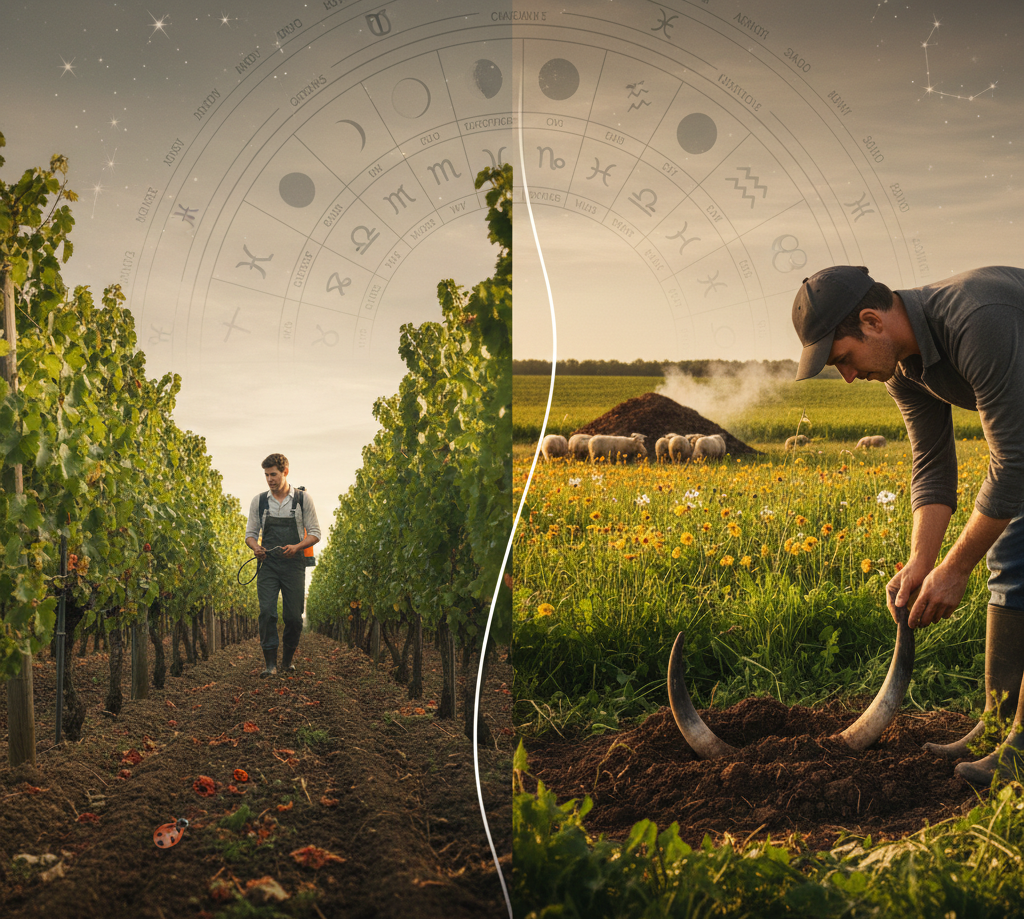
This is the question everyone asks, and the distinction matters.
Organic wine means the grapes are grown without synthetic pesticides, herbicides, or fertilisers. In the EU, organic certification also limits sulphite additions in the cellar. It is primarily about what you do not use.
Biodynamic wine includes all organic requirements and then goes further. It adds:
A cosmic farming calendar that divides days into four types (Root, Leaf, Flower, and Fruit) based on the moon's position relative to the zodiac constellations. Different vineyard tasks are timed to different days: harvesting on a Fruit day, for instance, when fire-sign energy is believed to bring out the most vibrant expression of the grape.
Nine specific preparations (numbered 500 to 508) made from natural materials like quartz, chamomile, yarrow, dandelion, valerian, oak bark, horsetail, and cow manure. These are applied in tiny quantities to the soil and compost to stimulate microbial life and build long-term soil health. The most well-known, Preparation 500, involves packing cow manure into a cow horn and burying it over winter. When it is dug up in spring, the transformed contents are stirred into water and sprayed across the vineyard. Strange? Undeniably. Effective? The results speak for themselves.
Biodiversity requirements. Certified biodynamic farms must dedicate at least 10% of their land to non-crop biodiversity: hedgerows, wildflower meadows, wetlands, or woodland. The vineyard is not a monoculture; it is an ecosystem.
A self-sustaining closed system. The ideal biodynamic farm generates its own fertility through composting, cover crops, and livestock. Nothing comes in from outside that does not need to.
Think of it this way: organic farming is about avoiding harm. Biodynamic farming is about actively building life.
The Biodynamic Calendar: Root, Leaf, Flower, Fruit
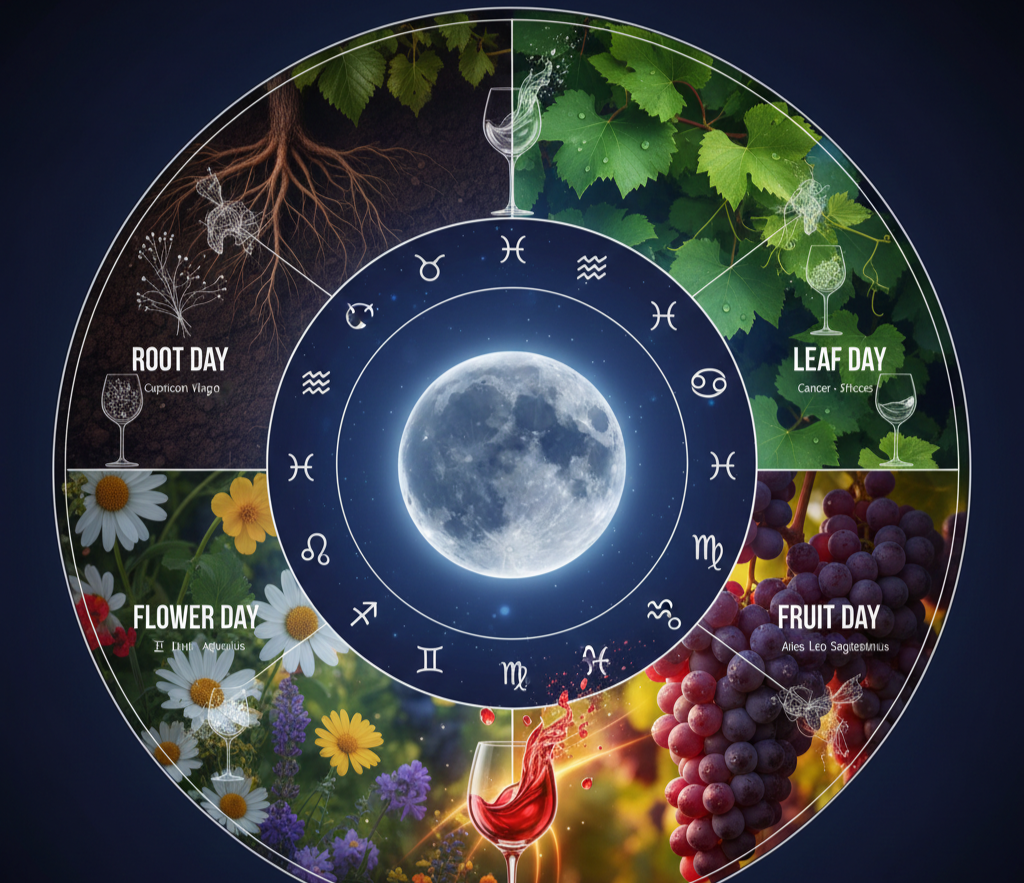
One of the most distinctive aspects of biodynamic viticulture is the farming calendar, originally developed by Maria Thun based on decades of observation and research. It divides each day into one of four categories depending on which zodiac constellation the moon is passing through:
Root Days (Earth signs: Capricorn, Taurus, Virgo). These are days for working on the soil, ploughing, and tending to root systems. In the cellar, wines are said to taste more restrained and mineral on Root days.
Leaf Days (Water signs: Cancer, Scorpio, Pisces). Good for watering and tending to foliage. Wines may show a leafy, more herbal quality.
Flower Days (Air signs: Gemini, Libra, Aquarius). Ideal for lighter vineyard work. Aromatic wines in particular are said to shine on Flower days.
Fruit Days (Fire signs: Aries, Leo, Sagittarius). The best days for harvesting and, according to many producers, the best days for tasting wine. Fruit flavours are said to be more vibrant and expressive.
Does the calendar actually affect how wine tastes in the glass? The scientific evidence is mixed, but it is worth noting that several major UK retailers schedule their press tastings on Fruit days, and some of the world's most respected producers refuse to open their wines on Root days. Whether you believe in the mechanism or not, paying close attention to natural rhythms tends to produce more attentive, more thoughtful farming, and that shows in the bottle.
What Does Biodynamic Wine Taste Like?
Biodynamic wines do not taste like a single category. A biodynamic Riesling from Alsace will taste entirely different from a biodynamic Syrah from the Languedoc. The grape, the region, and the winemaker's hand still determine the character of the wine.
What many tasters notice, though, is a quality that is hard to pin down but easy to recognise: a sense of life in the glass. Biodynamic wines are often described as more vibrant, more transparent to their place of origin, and more expressive of terroir. The wines tend to have a certain clarity and energy that conventional wines sometimes lack.
In a blind tasting conducted by Fortune magazine, seven expert tasters (including a Master of Wine and head sommeliers) compared ten pairs of biodynamic and conventionally made wines. Nine out of ten times, the biodynamic wine was judged superior, with tasters noting better expressions of terroir in the aroma, flavour, and texture.
This is not magic. When you farm with greater attention to soil health, biodiversity, and natural balance, the grapes that come off the vine tend to be more expressive. Healthy soil produces healthy vines, and healthy vines produce grapes that need less intervention in the cellar. The wine speaks for itself.
Who Certifies Biodynamic Wine?
Two main organisations certify biodynamic wine:
Demeter International is the world's oldest ecological certification body, established in 1928. It operates in over 50 countries and certifies vineyards, farms, and processed products including wine. To carry the Demeter seal, 100% of the grapes must come from a Demeter-certified vineyard, and the winery must follow strict processing standards. The certification process takes a minimum of three years.
Biodyvin certifies around 100 European wineries, exclusively in viticulture. It is a smaller, more specialised body focused solely on biodynamic wine production.
It is worth knowing that some excellent producers farm biodynamically without seeking certification. The process is rigorous and expensive, and some winemakers prefer to put the money into their farming instead. If a producer tells you they farm biodynamically, it is always worth asking whether they are certified and by whom, but the absence of a logo on the label does not necessarily mean the absence of biodynamic practices.
Biodynamic Producers We Love
At Vino Cosmo, biodynamic wine is at the heart of everything we do. Here are some of the producers whose wines you will find at our tastings:
Ricardelle de Lautrec (Languedoc, France). A family estate producing a stunning range of biodynamic wines, from crisp Pet Nat to a bold Chardonnay Orange and a deeply expressive red blend. Their wines are vibrant, precise, and full of character. You will find Ricardelle at almost every Vino Cosmo tasting.
Domaine des Garcons (Beaujolais, France). A biodynamic producer making beautifully honest Gamay: no oak, no artifice, just bright red fruit and clean mineral structure. Their Beaujolais is the kind of wine that reminds you why this grape deserves more respect.
Zind-Humbrecht (Alsace, France). Olivier Humbrecht MW farms Europe's steepest vineyard with horses and produces some of the world's most acclaimed biodynamic Rieslings, Gewurztraminers, and Pinot Gris. A true pioneer.
Marcel Deiss (Alsace, France). Famous for reviving the traditional Alsatian practice of field blends, planting multiple grape varieties together in the same vineyard and harvesting them as one. Radical, beautiful wines.
The Controversy: Is Biodynamics Pseudoscience?
Let's address the cow horn in the room.
Biodynamic farming includes practices that look, to a modern scientific eye, eccentric. Burying cow horns stuffed with manure. Timing harvests to the position of the stars. Spraying preparations in quantities so small they are sometimes compared to homeopathy.
Critics argue that the improvements biodynamic producers report could be achieved through organic farming alone, without the mysticism. They have a point: there is limited peer-reviewed evidence that the specific preparations or the cosmic calendar produce measurable effects beyond what organic practices achieve.
But here is what the critics often miss. The results are real. Biodynamic vineyards consistently produce wines of extraordinary quality, and the producers who practise biodynamics tend to be among the most attentive, most dedicated, and most skilled farmers in the world. Whether the cow horn is the mechanism or simply a symbol of a deeper commitment to the land, the wines in the glass tell a compelling story.
As the wine writer Ray Isle put it: does it matter if they also think burying cow horns will channel cosmic life forces, if the wine is extraordinary?
At Vino Cosmo, we are not here to tell you what to believe. We are here to pour you a glass of biodynamic wine and let you taste the difference for yourself.
How to Find Biodynamic Wine
Look for the Demeter or Biodyvin logos on the label. These are your guarantee of certified biodynamic production.
In London, biodynamic wines are increasingly easy to find. Many natural wine bars and independent wine shops stock them, and the selection is growing every year. Ask your local wine merchant about their biodynamic range, and you might be surprised by what they have.
Or come to a Vino Cosmo tasting. Every wine we pour is biodynamic, and every event is timed to a new or full moon, connecting the wine in your glass to the same cosmic rhythms that guided its creation.
Vino Cosmo hosts biodynamic wine tastings in London timed to the lunar calendar. Follow us on Instagram @vinocosmo.