

Natural wine vs biodynamic wine: what's actually the difference?
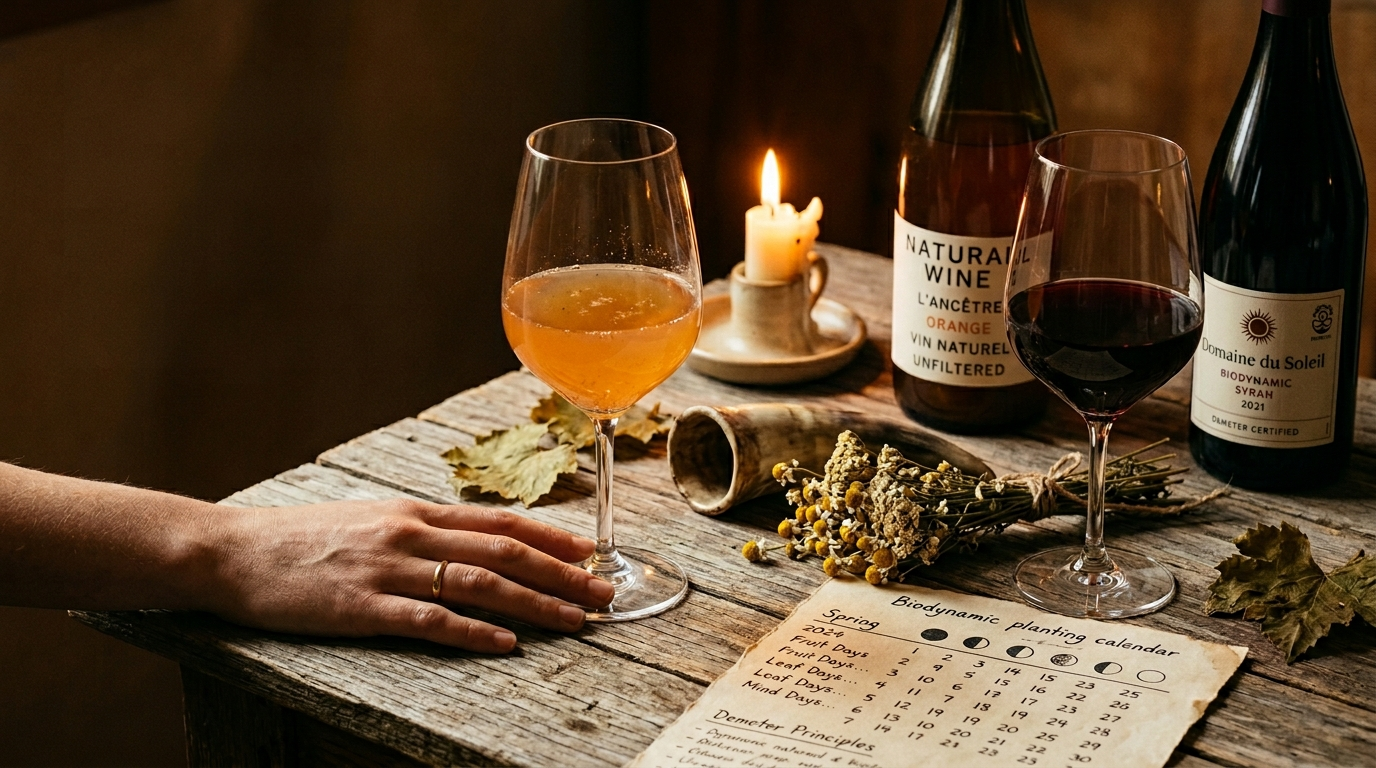
They get lumped together constantly. They're not the same thing.
People use "natural" and "biodynamic" interchangeably. At tastings, at dinner parties, on Instagram. Someone holds up a cloudy orange wine and calls it biodynamic. Someone else sees a Demeter-certified Burgundy and calls it natural. Both are usually wrong.
These are two different ideas about wine. One is about what happens in the cellar. The other is about what happens in the soil. They overlap sometimes, but they answer different questions, and understanding the distinction will change how you drink.
Natural wine is a cellar philosophy
Natural wine is about intervention, or the refusal of it. The goal is to let the grape become wine with as little interference as possible. No commercial yeasts. No enzymes. No added tannins. Fermentation happens with whatever is already living on the grape skin and in the cellar air.
The only additive most natural winemakers accept is a small amount of sulfur dioxide at bottling, maybe 10 mg/L for reds, 25 mg/L for whites. Some add none at all.
Here's the catch: there is no official certification for natural wine. No governing body. No inspections. No legal definition in most countries. France has "Vin Méthode Nature," which is the closest thing, but it's not widely adopted. When a winemaker calls their wine natural, they're making a personal claim, not meeting a verified standard.
This is not a criticism. Some of the most honest, alive wines I've tasted come from producers who would never bother with a certification. But it does mean the word "natural" on a bottle tells you less than you might think.
Biodynamic wine is a farming philosophy
Biodynamic agriculture was developed by Rudolf Steiner in 1924, decades before organic farming had a name. It starts with a simple premise: the vineyard is a living organism, not a factory. Soil, plant, animal, season, and cosmos are all connected.
In practice, this means following a lunar calendar for planting, pruning, and harvesting. It means using nine specific preparations, numbered 500 through 508, made from things like cow manure buried in a cow horn over winter, ground quartz, yarrow, chamomile, and nettle. These are stirred into water and applied to soil and vine at specific times.
Preparation 500 is the one people find strangest. A cow horn packed with manure, buried in autumn, dug up in spring. The resulting substance is diluted in water, stirred rhythmically for an hour, and sprayed across the vineyard at dusk. It is meant to stimulate root growth and soil life.
You either find this beautiful or absurd. Many people find it both.
Unlike natural wine, biodynamic farming has strict certification through Demeter. Annual inspections. Three years of biodynamic practice before you can carry the label. At least 10% of the farm's land must be set aside for biodiversity. Every requirement that applies to organic farming applies here too, plus the preparations, plus the calendar, plus the holistic land management.
When you see the Demeter mark, it means something specific and verified. That clarity is worth a lot.
Where they overlap (and where they don't)
This is where people get tripped up. Biodynamic describes how grapes are grown. Natural describes how wine is made. Different stages of the process entirely.
A wine can be biodynamic without being natural. A Demeter-certified estate could farm by the lunar calendar, bury cow horns, preserve biodiversity corridors between their vines, and then bring the grapes into a modern cellar and add commercial yeasts, fine with egg whites, and filter aggressively. The farming was biodynamic. The winemaking was conventional.
A wine can be natural without being biodynamic. A winemaker could buy grapes from a neighbour who farms conventionally, bring them to their cellar, ferment with wild yeast, add nothing, bottle unfined and unfiltered. The winemaking was natural. The farming was not.
The wines that excite people most are usually both — biodynamically farmed grapes made into wine with minimal intervention. The farming gives the grape depth. The hands-off cellar work lets that depth speak. But this overlap is a choice, not a requirement.
The science question (honestly)
Organic farming practices work. That is well-documented. Cover crops, composting, avoiding synthetic pesticides — the ecological benefits are clear.
The biodynamic preparations are harder to pin down. Studies comparing biodynamic preparations to standard organic compost have not found consistent, statistically significant differences in vine health or yield. Critics say the preparations are esoteric ritual rather than agriculture.
But producers who practise biodynamics for years often report something harder to pin down. Vines that seem more resilient. Soils that feel different underfoot. Fruit with more personality. I've stood in biodynamic vineyards next to conventional ones and felt a difference I couldn't explain. That doesn't make it science. It does make it interesting.
The farming practices are sound. The cosmic dimension asks for a kind of faith. Whether that faith produces better wine or just forces winemakers to pay closer attention to their land, the result is often the same: the wine is good. Sometimes startlingly good.
What to look for when you're buying
If a bottle says "natural wine" — ask the shop or the producer what they mean by it. There is no standard, so the word covers everything from pristine minimal-intervention wines to bottles that smell like a farmyard. Neither is wrong. But know what you're getting.
If a bottle carries the Demeter certification — you know exactly how the grapes were farmed. You don't necessarily know what happened in the cellar, but you know the soil was treated with care and the vineyard was managed as a whole living system.
If a bottle says "organic" — the grapes were grown without synthetic pesticides or herbicides, but the winemaking can still be fairly interventionist. Organic is the baseline. Biodynamic goes further. Natural goes in a different direction entirely.
The best approach, as with most things in wine, is to taste. Try a biodynamic Burgundy alongside a natural Jura alongside a conventional Bordeaux. Let your palate do what no label can.
Why this matters to us
At Vino Cosmo, everything we do is rooted in biodynamic winemaking. Our tastings follow the lunar calendar. We pour wines from producers who farm by the moon and trust the soil. We believe the cosmos has something to say about what's in your glass.
But we also believe in honesty about what these words mean. "Natural" and "biodynamic" are not interchangeable lifestyle labels. They are specific philosophies with specific practices, and the wines they produce taste different for real reasons.
Once you understand the difference, you taste it. A biodynamic Chenin Blanc from the Loire has an earthiness that comes from the soil being cared for like a living thing. A natural Gamay from Beaujolais has a wildness you won't find in a filtered, fined, adjusted version of the same grape. And a wine that was both, farmed by the moon and left alone in the cellar, that's something else entirely.
That's what we pour.